

You might want to express milk if:
- you have to be away from your baby, for example, because your baby is in special care or because you're going back to work
- to soften your breasts and make it easier for the baby to latch if your breasts feel uncomfortably full (engorged)
- your baby is not able to latch or suck well, but you still want to give them breast milk
- you want to boost your milk supply
How to express breast milk
You can express milk by hand or with a breast pump. How often you express your milk, and how much you express, will depend on why you're doing it. Please ask your midwife or health visitor for advice specific to your individual needs.
Sometimes it takes a little while for your milk to start flowing. Try to choose a time when you feel relaxed. Having your baby (or a photo of them) nearby can help you release oxytocin and help your milk to flow.
Expressing breast milk by hand
Some find it easier to express milk by hand, especially in the first few days or weeks. It also means you can express without needing a pump, or an electricity supply.
These tips may help:
- Before you start, wash your hands with soap and warm water.
- Have something clean ready to collect the milk in.
- Some find gently massaging their breasts before expressing helps their milk to let down.
- Cup your breast with one hand then, with your other hand, form a "C" shape with your forefinger and thumb.
- Squeeze gently, keeping your finger and thumb a few centimetres away from your nipple, just outside the darker area around it (areola). Do not squeeze the nipple itself as you could make it sore. This should not hurt.
- Release the pressure, then repeat, building up a rhythm. Try not to slide your fingers over the skin.
- Drops should start to appear, and then your milk usually starts to flow.
- If no drops appear, try moving your finger and thumb slightly, but still avoid squeezing the darker area near your nipple.
- When the flow slows down, move your fingers round to a different section of your breast, and repeat.
- When the flow from one breast has slowed, swap to the other breast. Keep changing breasts until your milk drips very slowly or stops altogether.
Watch a video about expressing milk by hand on the UNICEF website
Expressing milk with a breast pump
There are 2 different types of breast pump: manual (hand-operated) and electric.
Manual pumps are cheaper but may not be as quick as an electric pump.
- The suction strength can be altered on some electric pumps. Setting the strength too high straight away may be painful or damage your nipple. You will also be able to get different funnel (the part that goes over your nipple) sizes to fit your nipples, and getting the right size ensures comfort and optimum expressing.
If you're having difficulty expressing breast milk
The pump should never cause bruising or catch your nipple as it's sucked into the funnel. Please ask your midwife or health visitor for support if it is painful to pump, you have any nipple damage from pumping, or you are not managing to express increasing amounts of breast milk.
Storing breast milk
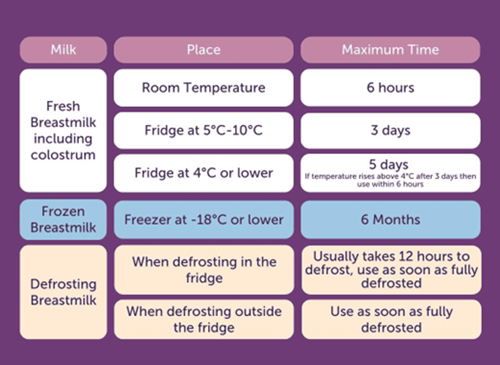
You can store breast milk in a sterilised container or in special breast milk storage bags:
- in the fridge for up to 5 days at 4C or lower (you can buy fridge thermometers online) – if you're not sure of the temperature of your fridge, or it is higher than 4C, use it within 3 days
- for 2 weeks in the ice compartment of a fridge
- for up to 6 months in a freezer, if it's -18C or lower
Storing breast milk in small quantities will help avoid waste. If you're freezing it, make sure you label and date it first.
Defrosting frozen breast milk
It's best to defrost frozen breast milk slowly in the fridge before giving it to your baby. If you need to use it straight away, you can defrost it by putting it in a jug of warm water or holding it under running warm water.
Once it's defrosted, give it a gentle shake if it has separated. Use it straight away. Do not re-freeze milk that's been defrosted.
Once your baby has drunk from a bottle of breast milk it should be used within 1 hour and anything left over should be thrown away.
Warming breast milk
You can feed expressed milk straight from the fridge if your baby is happy to drink it cold. Or you can warm the milk to body temperature by putting the bottle in a jug of warm water or holding it under running warm water.
Do not use a microwave to heat up or defrost breast milk. This can cause hot spots, which can burn your baby's mouth.
If exclusively pumping then the following is a useful guide to ensure everything is going as it should:
|
Frequency of expression |
At least 8-10 times in 24 hours including once during the night. |
|
Timings of expressions |
Timings work around lifestyle – cluster expressing, no long gaps between expressions |
|
Stimulating milk ejection |
Use breast massage, relaxing, skin contact and/or being close to baby. Photos or items of baby clothing to stimulate oxytocin |
|
Hand expression |
Confident with technique |
|
Using a breast pump |
Access to electric pump. Effective technique including suction settings, correct funnel fit. Double pumping (or switching breasts) to ensure good breast drainage. Use massage and/or breast compression to increase flow. |
|
Breast condition |
Breast fullness prior to expression which softens following expression. No sore areas or nipple trauma. |
|
Milk flow |
Good milk flow. Breasts feel soft after expression |
|
Milk volumes |
Gradual increases in 24 hr volume |
For those loaning breast pumps from the Maternity Unit
- Pumps are loaned for a 2 week period and then need returning to the ward
- Pumps are loaned free of charge
- You will be given an electric pump and 2 breast pump kits
- You will be measured for the correct funnel size
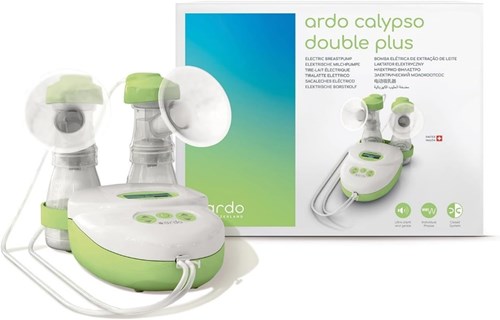
To use the breast pump:
- Double pump (either express from both breasts at once or one after the other). Double pumping helps support your supply if you are exclusively pumping. If you feel you have too much milk and are uncomfortable then please speak with your midwife.
- Do some gentle breast massage prior to expressing to help release oxytocin and support milk flow, try and have your baby or a picture of your baby close by.
- Follow the pumping poem below:
To get your milk to start to flow
Set the cycles high and the vacuum low.
Once the milk starts to flow,
Set the vacuum higher and the cycles lower.
Doing this helps mimic a baby’s sucking pattern on the breast.
- Pump for approx. 15-20 minutes or stop before this if your milk stops flowing.
- Either feed the baby the expressed milk or store for a later date.
- Clean the pump in hot soapy water and sterilise the breast pump and bottles used. The cap and tubing on the breast pump do not need washing as no milk comes into contact with this part.
Responsibilities of loanee:
- Use equipment as per instructions that come with the pump
- Report any damage to the equipment at the earliest possible time
- Store equipment safely and securely
- Only use the pump for as long as clinically indicated
- Return the pump in full working order once your individual feeding plan support has been completed/or your baby is discharged from our service.